Beacon’s AI Supply Chain Workspace turns fragmented data into intelligent supply chains - focusing on reducing unnecessary spend across the supply chain.
The difference between seeing a delay and understanding it
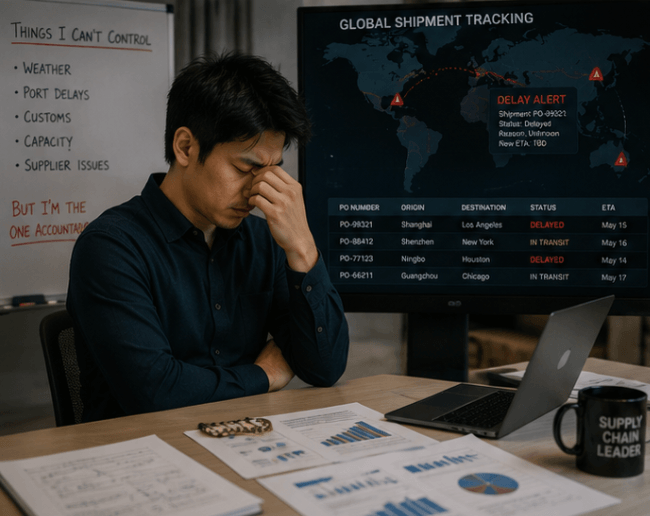
Most supply chain teams I speak to have a visibility tool. They get a notification when a container slips off plan. The dashboard goes red. Someone on the team gets the email.
Then what?
That is the question I think the industry doesn't talk about enough. The alert tells you a shipment is late. It does not tell you why it is late, whether you have seen this lane fail before, who is on the hook for it, or what it is about to cost you. None of those are technicalities. They are the things that decide what you actually do next.
Seeing a delay is the easy part. Understanding it is where the real work begins.
Alerts without context create more work, not less
Talk to any senior operator and they will tell you the same thing: the volume of exceptions they manage has gone up, not down, since they bought a visibility tool. More feeds. More dashboards. More red flags. The underlying job, working out what to do about each one, hasn't got any easier.
That is because an alert without context is just noise routed faster. You still have to open three other systems to answer the question that matters. Is this carrier slipping on this lane every week, or is this a one-off? Is the SKU on board safety-critical or low-priority? Did we agree free days that haven't been counted properly? Is there an air freight option that costs less than the demurrage exposure we're walking into?
Those answers live in different places. The carrier portal. The ERP. The freight invoice. A spreadsheet on someone's desktop. An email thread from three weeks ago. Visibility tools surface the symptom. They were never designed to connect it back to the operational context that explains it.
This is part of why 95% of enterprise AI pilots have delivered zero measurable ROI, according to MIT's NANDA initiative. The models are not the bottleneck. The data foundation under them is fragmented. An AI that surfaces a late shipment without knowing the lane history, the customer impact, or the financial cost is, in practice, doing the same job as a 2018 dashboard. Faster. Not smarter.
What "understanding a delay" actually means
A delay is a four-dimensional event. Most tools treat it as one-dimensional.
The first dimension is pattern. Is this carrier-lane combination slipping consistently? In our Flying Blind research, one supply chain leader was planning US-bound shipments on a 35-day transit time. Actual times had drifted to 45 to 55 days. The ERP did not know. The visibility tool was showing real ETAs, but no one was connecting them back to the planning logic. The delay was systemic. The system was treating each instance as an isolated incident.
The second dimension is accountability. Is this on the carrier, the forwarder, the supplier, or our own dwell at origin? Most exception logs don't capture this cleanly, which means the same root cause shows up again and again and no one is positioned to fix it.
The third dimension is financial impact. A late container destined for safety stock is a different problem from a late container feeding a production line tomorrow. The cost of acting (expediting, splitting the shipment, paying premium freight) needs to be weighed against the cost of not acting (stockouts, D&D charges, line shutdowns). According to our Flying Blind research, emergency air freight to recover delayed ocean shipments routinely runs at four to six times the ocean cost. That number should drive the decision, not the colour of the dashboard. The Federal Maritime Commission has documented that nine major carriers collected roughly $15.4 billion in detention and demurrage over five years. Most of that gets treated as background noise. It doesn't have to be.
The fourth dimension is action. Once you know the pattern, the owner, and the cost, what do you actually do? And, just as important, what do you do next time so the same exception doesn't reappear?
The compounding part
There is a quieter cost to seeing without understanding. Every delay your team works through is a chance to learn something about how your operation actually behaves. If that learning lives in someone's head, or in a tab of a spreadsheet no one updates, it disappears the moment that person leaves.
This is the institutional knowledge problem. The judgement your senior operators have built over years (which lanes to trust, which forwarders will own a problem, which carriers always blame the terminal) is the most valuable asset your supply chain has. It should not be trapped in messaging threads and personal notebooks.
When delays are understood instead of just seen, the explanation gets recorded. The pattern gets surfaced for the next time. The cost gets connected to the carrier scorecard. The lane gets flagged before the next bid season. The intelligence compounds.
The 2026 shift
We are at the start of a real change in how supply chain software works. The next layer is not a better tracking screen. It is an intelligence layer that connects the alert to the operational reality behind it.
The supply chain teams that pull ahead are not the ones with the most data feeds. They are the ones whose systems can answer "why is this happening, what does it cost, and what should we do about it" in seconds, not days. The data already exists inside most businesses. The technology to make it useful already exists. The window to build that foundation is right now.
If your current tool is telling you a container is late, and you're still opening four other tabs to work out what that actually means, you are not alone. Most teams are in the same position. But the gap is starting to widen between those who can move from seeing to understanding, and those who can't.
If you're rethinking what comes after tracking, we'd love to talk.

Are you overpaying for your ocean freight?