A trade lane (or trade route) refers to a specific pathway along which goods are transported between two or more locations, typically across international borders. Trade lanes are established based on the flow of goods and the economic relationships between countries or regions. They encompass both maritime and air routes and play a crucial role in global supply chains by facilitating the movement of goods and fostering international trade.
Transit time refers to the duration it takes for goods or shipments to travel from their origin to their destination. It is a crucial metric in supply chain and logistics management, as it directly impacts delivery schedules, inventory levels, and customer satisfaction. Transit time encompasses the entire journey of a shipment, including transportation, handling, and processing at various checkpoints along the route.
Transloading refers to the process of transferring goods or cargo from one mode of transportation to another, typically from one type of truck or railcar to another, or from rail to truck and vice versa. This logistical practice is often employed to optimize transportation routes, reduce costs, and improve overall efficiency in supply chain operations.
Transportation lead time refers to the duration it takes for goods to be transported from the point of origin to the final destination. It encompasses the time required for transportation activities, including loading, transit, and unloading, across various modes of transport such as road, rail, air, or sea.
A Transportation Management System (TMS) is a specialized software solution designed to streamline and optimize transportation and logistics operations within supply chains. It provides functionalities to effectively manage and control the movement of goods from origin to destination.
A transshipment is the process of transferring goods from one transportation vehicle or vessel to another during their journey from origin to destination. It typically occurs at intermediary points along the supply chain route, where cargo is transferred between different modes of transportation, carriers or vessels.
Twenty-foot Equivalent Unit (TEU) is a standard unit of measurement used in the shipping industry to quantify the cargo-carrying capacity of container vessels. It represents the volume of a standard twenty-foot-long shipping container.
An Ultra Large Container Vessel (ULCV) is a massive container ship used on major trade routes, capable of carrying over 14,000 TEUs.
Vendor Managed Inventory (VMI) is a supply chain management strategy where the supplier or vendor takes responsibility for managing the inventory levels of their products at the customer's or retailer's location. In this arrangement, the vendor monitors the inventory levels based on agreed-upon criteria such as sales data or inventory levels, and initiates replenishment as needed.
Verified Gross Mass (VGM) is a term used in the shipping industry to refer to the total weight of a packed container, including its contents and packaging materials. It is a crucial requirement mandated by the International Maritime Organization (IMO) under the Safety of Life at Sea (SOLAS) convention to enhance safety in maritime transportation.
A floating structure with its own mode of propulsion designed for the transport of cargo and/or passengers. In the Industry Blueprint 1.0 "Vessel" is used synonymously with "Container vessel", hence a vessel with the primary function of transporting containers.
Vessel bunching refers to the situation where multiple vessels arrive at a port simultaneously or within a short period, leading to congestion and delays. This clustering of vessels can overwhelm port facilities, causing extended wait times for berthing, loading, and unloading operations.
A vessel call sign is a unique identifier assigned to a ship for radio communication purposes. It is used to distinguish the vessel from others in maritime communication systems, including VHF radios and satellite communications.
A vessel omission (sometimes called a port omission) occurs when a scheduled vessel does not call at a planned port during its voyage. This disruption means that the vessel skips the port entirely, which can impact the transportation and delivery schedules of goods.
In cargo shipping, vessel rotation is the planned sequence of port calls that a shipping vessel follows on its route to optimize cargo loading and unloading operations.
The timetable of departure and arrival times for each port call on the rotation of the vessel in question.
A vessel sharing agreement (VSA) is a cooperative arrangement between shipping companies that allows them to share space and resources on vessels for specific routes.
A journey by sea from one port or country to another one or, in case of a round trip, to the same port.
Warehouse utilization is a logistics metric that refers to the effective use of available warehouse space for storing goods and inventory.
Order for specific transportation work carried out by a third party provider on behalf of the issuing party.
Logistics yard management refers to the process of overseeing and controlling the movement of trucks, trailers, containers, and other vehicles within a yard or distribution center. This includes tasks such as scheduling, tracking, and coordinating the arrival, departure, and storage of these vehicles.

Beacon Insider: February
February has flown by, and we've shipped two features that move Beacon closer to being the central workspace where your supply chain data, documents, and decisions all live together.
Document Upload: Your Supply Chain Data, In One Place
Running an AI Supply Chain Workspace is only as powerful as the data behind it. That's why we've made it significantly easier to get your supply chain data into Beacon.
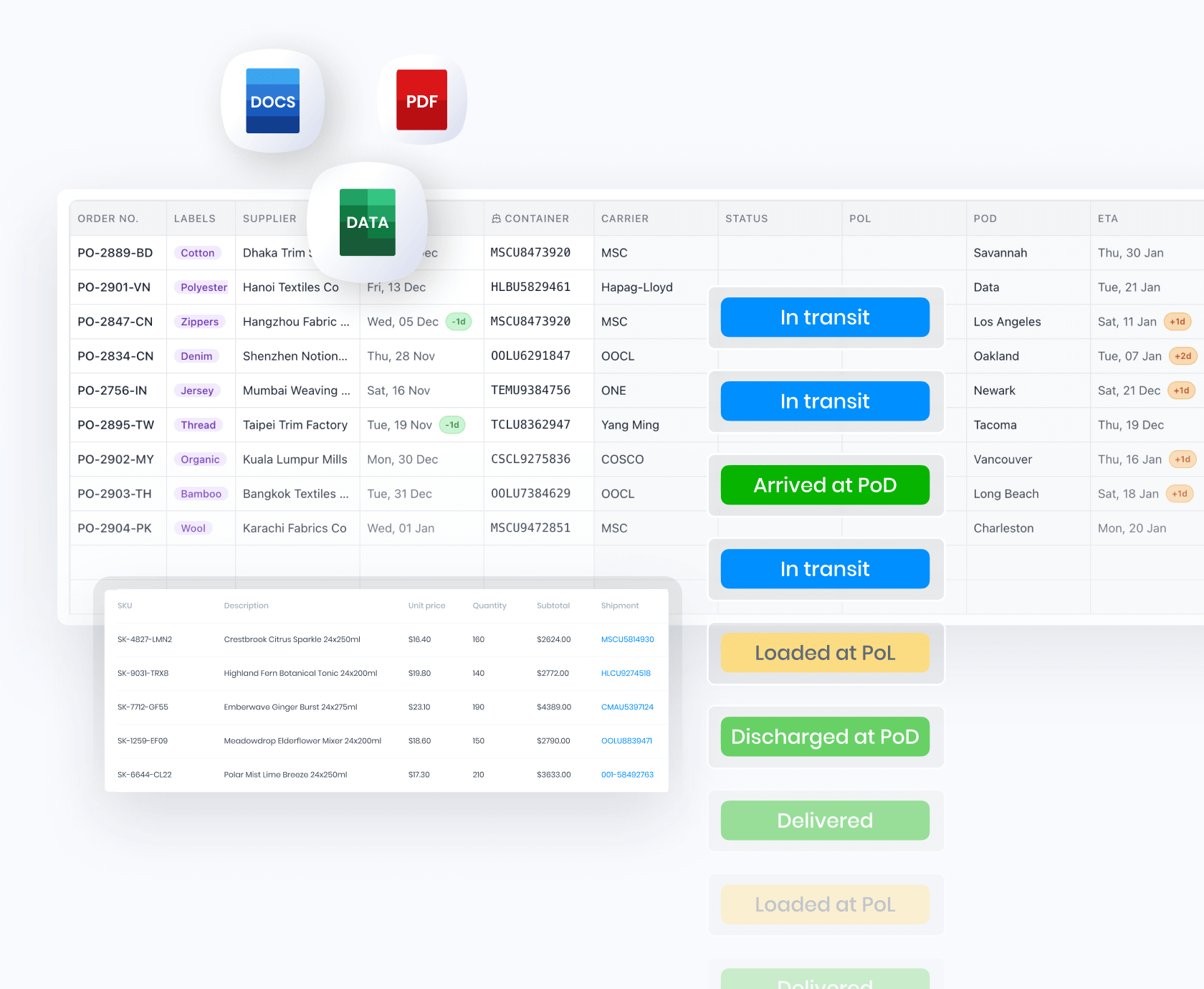
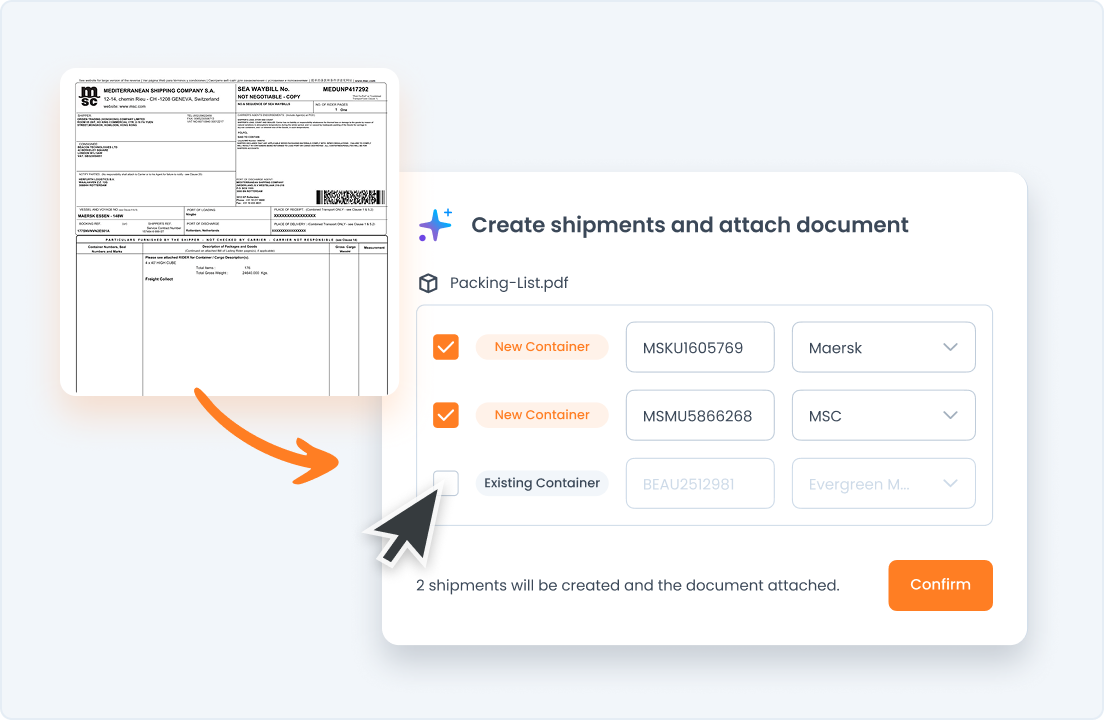
Packing lists, Bills of Lading, Master Bills can now be dragged and dropped directly into Beacon. Documents that used to sit in inboxes or shared drives are automatically extracted and populated into Beacon Table with vital SKU data extraction coming very very soon, so your workspace stays current without the manual work.
This matters because AI insights are only as good as the data they're built on. When your supply chain documents are centralised and standardised in one workspace, Beacon can surface reliable, contextual insights across your shipments via Reports. Fragmented data means fragmented visibility and decisions made in silos.

Order Creation via API: Keep Your Stack in Sync
Your supply chain doesn't run on one system, and your workspace shouldn't create extra work because of it. If orders are created in your ERP or another tool in your tech stack, you can now push them directly into Beacon via API, keeping your workspace accurate and up to date without duplication.
The goal is straightforward: one workspace where your team has a shared, reliable view of what's moving, what's needed, and what to do next. Connect your supply chain data today.