Key takeaways
To see what demurrage and detention cost on the P&L, post them to their own general ledger lines and accrue them when free time runs out, not when the invoice arrives. Rolled into freight, cost of goods sold or landed cost, the number has no owner, and no one checks the invoice against contract free time.
- Demurrage is charged while the full container is still inside the terminal after free time. Detention is charged after the container has left the terminal and is not returned empty in time. They are different clocks.
- If D&D is rolled into freight, cost of goods sold or a blended landed-cost rate, you cannot see the number, and you cannot tell who owns it.
- Under UK GAAP and IFRS, transport and handling that are directly attributable to bringing inventory to its present location and condition can sit in inventory cost. Costs that are not directly attributable, including abnormal waste, are expensed in the period. Agree the policy, then apply it consistently. (FRS 102 Section 13; IAS 2)
- Accrue D&D when free time has expired and chargeable days have been incurred, even if the invoice has not arrived. Waiting for the invoice puts the cost in the wrong month. (FRS 102 paragraph 2.36)
- A detention invoice cannot be checked from the invoice alone. Rebuild the charge from the contract (free time and rate tiers) and from shipment events (gate-out and empty return), then compare.
- Logistics, finance and procurement all touch D&D. Name one owner for the P&L line. If no one owns it, no one checks it.
- An ERP can store the invoice. It will not, on its own, complete a three-way match against the contract and the shipment. Beacon's freight invoice audit and verification covers ocean freight invoices, including D&D, against your contracts and shipments, and can be live in weeks for mid-market ocean importers.
This guide is for the finance lead who owns the month-end number, and for the operations lead who is asked why it moved. It covers ocean freight containers only. It will show you how detention is calculated, how to accrue the cost before the invoice arrives, and how to check the invoice against the free time in your contract.
What demurrage and detention actually are
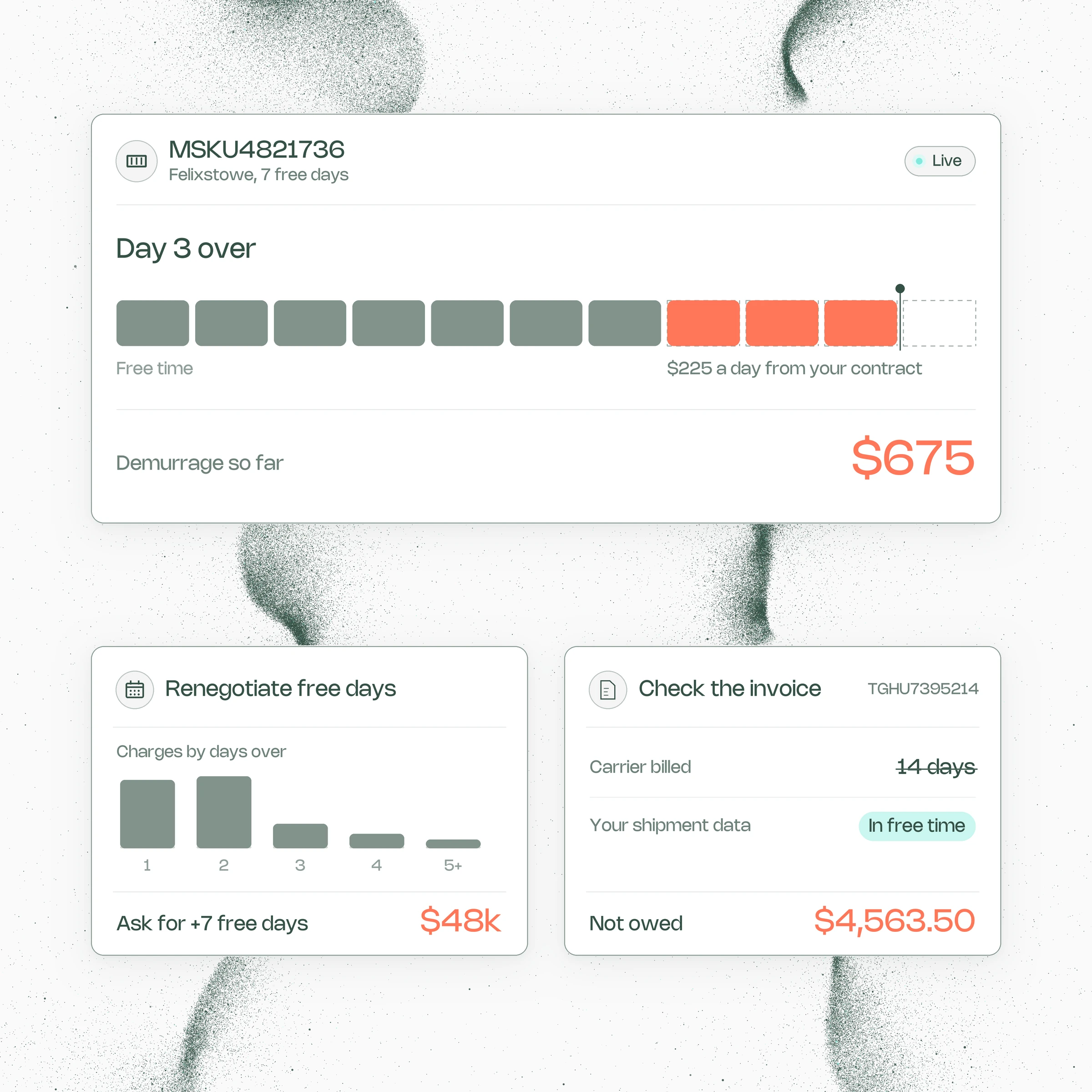
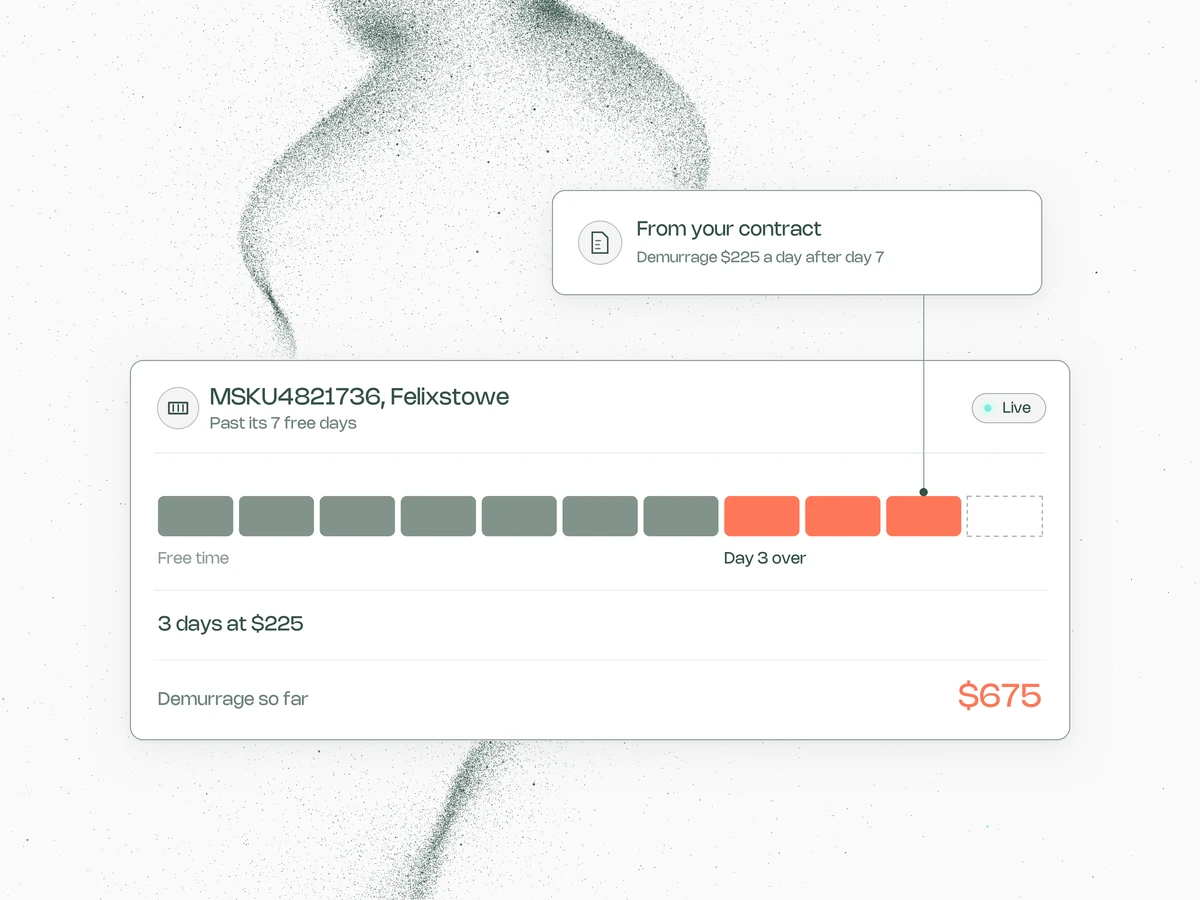
Demurrage is a charge for leaving a full container at the terminal after the free time in your contract has run out.
Detention is a charge for keeping the carrier's container outside the terminal after the free time for returning it empty has run out.
The two charges can appear on the same invoice, or as separate invoices, or inside a mixed freight bill. Some contracts give one combined free-time clock; others keep the clocks separate. Calendar days and working days are not interchangeable. The contract or the tariff that actually governs the shipment decides when each clock starts, whether the return date is a chargeable day, and which daily rate tier applies.
Terminal storage or quay rent is a different charge again. Do not treat it as demurrage without checking who billed it and which rule applies.
How do I see what demurrage and detention are costing us on the P&L?
You see the cost only if D&D is coded to its own general ledger lines, accrued in the month the chargeable days were incurred, and reported separately from ocean freight.
Start in the nominal ledger. Search for demurrage, detention, per diem, container charges, port charges and mixed freight or forwarding lines. Practitioner accounting guidance has described how these charges are often posted into a general freight expense account, which hides them inside a larger total and makes landed cost harder to see. (Wiss, "Drayage Cost Accounting")
Then decide, with your auditor if needed, where the cost should sit once you can see it:
- Its own P&L lines. One code for demurrage and one for detention, or a single D&D line with a clear sub-analysis. This is the only structure that lets finance explain the number and lets operations act on it.
- Rolled into freight. The invoice is paid, the cost disappears into ocean freight, and the month-end pack looks clean. You can no longer tell D&D from the base rate.
- Inside cost of goods sold, or absorbed into a landed-cost rate. Under FRS 102 Section 13, the cost of inventories includes the purchase price, import duties and other non-recoverable taxes, and "transport, handling and other costs directly attributable to the acquisition" of the goods (paragraphs 13.5 and 13.6). Other costs may be included only to the extent they bring the inventories to their present location and condition (paragraph 13.11). IAS 2 sets the same test for companies reporting under IFRS. FRS 102 also requires abnormal amounts of wasted materials, labour or other production costs, and storage costs that are not necessary to the production process, to be expensed in the period (paragraph 13.13). Whether a particular D&D charge is inventoriable or a period expense depends on the facts and on the policy you adopt. What matters for management reporting is that the charge remains identifiable, even if part of it is capitalised.
If the amount is hidden inside landed cost, it still hits gross margin when the stock is sold, just later, and still with no owner.
Do not rely on invoices paid in the period. Include accruals for chargeable days already incurred, invoices under query, and any credits once they are agreed. Otherwise the P&L understates the cost in the month the container ran past free time, and overstates it when the bill arrives.
Who should own the D&D number?
Name one owner for the P&L line. Logistics, finance and procurement all touch the charge; none of them owns it by default.
- Logistics and operations see the events: discharge, availability, gate-out, empty return, and the reason a clock ran over.
- Finance owns the recognition: the accrual, the coding, the cut-off, and the inventory policy.
- Procurement sees the contract: the free-time allowance, the rate tiers, and which amendment applies.
When detention is invisible inside a freight line, operations cannot see a receiving delay in the numbers. When demurrage is invisible, documentation or collection delays never show up as a cost. That is a coding problem as much as an operations problem. (Wiss)
A useful split is: finance owns the line and the accrual; logistics owns the explanation of chargeable days; procurement owns the contract record that finance uses to check the invoice. If those three jobs are left implicit, each team assumes another team already checked it.
How are detention charges calculated, and how do I check the invoice is right?
Detention is calculated as chargeable days multiplied by the daily rate that applies to each of those days. Chargeable days are the days after free time has ended, measured from the events in your contract, not from the invoice date.
You check the invoice by rebuilding that sum yourself: take the free time and the rate tiers from the contract or tariff that governs the shipment, take the event dates from the shipment record, recompute day by day, and compare the result with the invoice.
The invoice will not always carry the event dates the clock turns on. On US trades, Federal Maritime Commission rules require a demurrage or detention invoice to include, among other things, the allowed free time, the start and end dates of free time, the dates for which the charge is billed, the applicable rule and the specific rate or rates (46 CFR 541.6). Those rules do not require the gate-out or empty-return dates themselves. They also do not apply to every UK import. In every trade, you still need the shipment record to confirm that the free-time window and the chargeable days on the invoice match what actually happened.
Worked detention calculation (illustrative example only)
The dates, free time and rates below are an example, for a single import container, so you can see the arithmetic. They are not a market rate, a Beacon average, or the terms of any named contract. Use your own contract and your own event dates.
Assumptions in this example
- Detention free time is 5 calendar days, starting the day after gate-out.
- The empty-return date is a chargeable day if it falls after the last free day.
- Rates are tiered: £70 per day for chargeable days 1 to 4, and £110 per day from chargeable day 5 onwards.
Events
| Step | Date in this example |
|---|---|
| Container gated out of the terminal | Tuesday 3 November 2026 |
| Free time starts (day after gate-out) | Wednesday 4 November 2026 |
| Last free day | Sunday 8 November 2026 |
| First chargeable day | Monday 9 November 2026 |
| Empty container returned | Saturday 14 November 2026 |
| Chargeable days | 9 to 14 November 2026, which is 6 days |
Rates applied
| Chargeable days | Days | Daily rate (example) | Amount |
|---|---|---|---|
| Days 1 to 4 | 4 | £70 | £280 |
| Days 5 to 6 | 2 | £110 | £220 |
| Total detention in this example | 6 | £500 |
If the invoice shows a different total, the difference will sit in one of these places: the free-time allowance, the day the clock started, whether the return date was counted, the tier boundaries, or the rate itself. Check the contract amendment that was in force on the price-calculation date, not an older rate card and not the invoice's own narrative on its own.
If your contract uses a combined demurrage and detention clock, or working days rather than calendar days, rebuild the example on those rules. Do not borrow the assumptions above.
How do I accrue for demurrage and detention charges before the invoices arrive?
Accrue D&D in the period the chargeable days were incurred, using the same rebuild as when you check the invoice: contract free time, contract rates, and shipment events. Reverse or true-up the accrual when the invoice arrives.
FRS 102 requires financial statements, except cash-flow information, to be prepared on the accrual basis: items are recognised when they meet the definitions and recognition criteria, not when cash is paid (paragraph 2.36). A D&D charge that has already been incurred, but not yet invoiced, is a present obligation. Waiting for the supplier's invoice moves the cost into a later month and makes the P&L unusable as a control.
A practical month-end method:
- List every ocean container whose demurrage or detention clock has started, or has already expired, and for which no invoice has been posted.
- For each container, read the free time and rate tiers from the governing contract or tariff.
- Read the relevant events from the shipment record: for demurrage, availability and gate-out (or the event your contract uses); for detention, gate-out and empty return, or the container's status if it has not yet been returned.
- Compute chargeable days up to the period-end date, apply the tiers, and accrue that amount.
- When the invoice arrives, match it to the accrual, post the difference, and keep a record of any amount still under query.
If your inventory policy capitalises a portion of D&D, the debit may go to inventory or to cost of goods sold rather than to a period expense. The credit is still an accrual. The rebuild does not change.
Do not accrue a round "management estimate" with no container list behind it. The estimate should be reconcilable, container by container, to events and to the contract.
How do I check demurrage and detention invoices against the free time in our contract?
Check a D&D invoice with a three-way match: the invoice, the free time and rates in the governing contract (including amendments), and the shipment events that start and stop the clock.
The invoice tells you what you are being asked to pay. It does not prove that free time was applied correctly, and it does not prove that the underlying events occurred on the dates used to count the days.
Work through this list for each container on the invoice:
- Confirm the bill of lading and the container number match the shipment.
- Identify the contract or tariff, and the amendment, that governed on the price-calculation date.
- Read the free-time allowance, whether the clocks are combined or separate, and whether days are calendar or working days.
- Confirm the start of free time against the event your contract uses (for example, availability, gate-out, or empty return).
- Confirm the end of free time and the first chargeable day.
- Confirm the empty-return or gate-out date from the shipment record, not only from the invoice.
- Rebuild chargeable days and apply the rate tiers, as in the example above.
- Check whether the same days have been billed twice, once as demurrage and once as detention, or as terminal storage under another name.
- Check the query window in the contract. Some clauses are much shorter than the payment terms on the same document.
For shipments in US trades that fall under the Federal Maritime Commission's billing rules, also check that the invoice contains the minimum information in 46 CFR 541.6. Under 46 CFR 541.5, failure to include that minimum information eliminates the obligation to pay the applicable charge. That is a US rule. Do not assume the same statutory consequence applies to a UK invoice that is not in scope.
The same method is set out, for ocean freight invoices more generally, in How to check whether your ocean freight invoices are correct.
A checklist for month end
- D&D has its own general ledger lines, or a sub-analysis that can be extracted from freight or landed cost without a manual hunt.
- One named owner is accountable for the P&L number.
- Every open container past free time has an accrual, rebuilt from the contract and from events, not from a lump-sum guess.
- Accruals from the prior period have been matched to invoices or rolled forward with a reason.
- Each D&D invoice posted in the period has been checked against contract free time and against shipment events.
- Combined clocks, calendar versus working days, and tier boundaries have been taken from the contract that actually applies.
- Query deadlines have been read before the invoice is approved.
- Credits, once agreed, are visible on the same line as the gross charge, so the net cost remains in view.
How Beacon helps
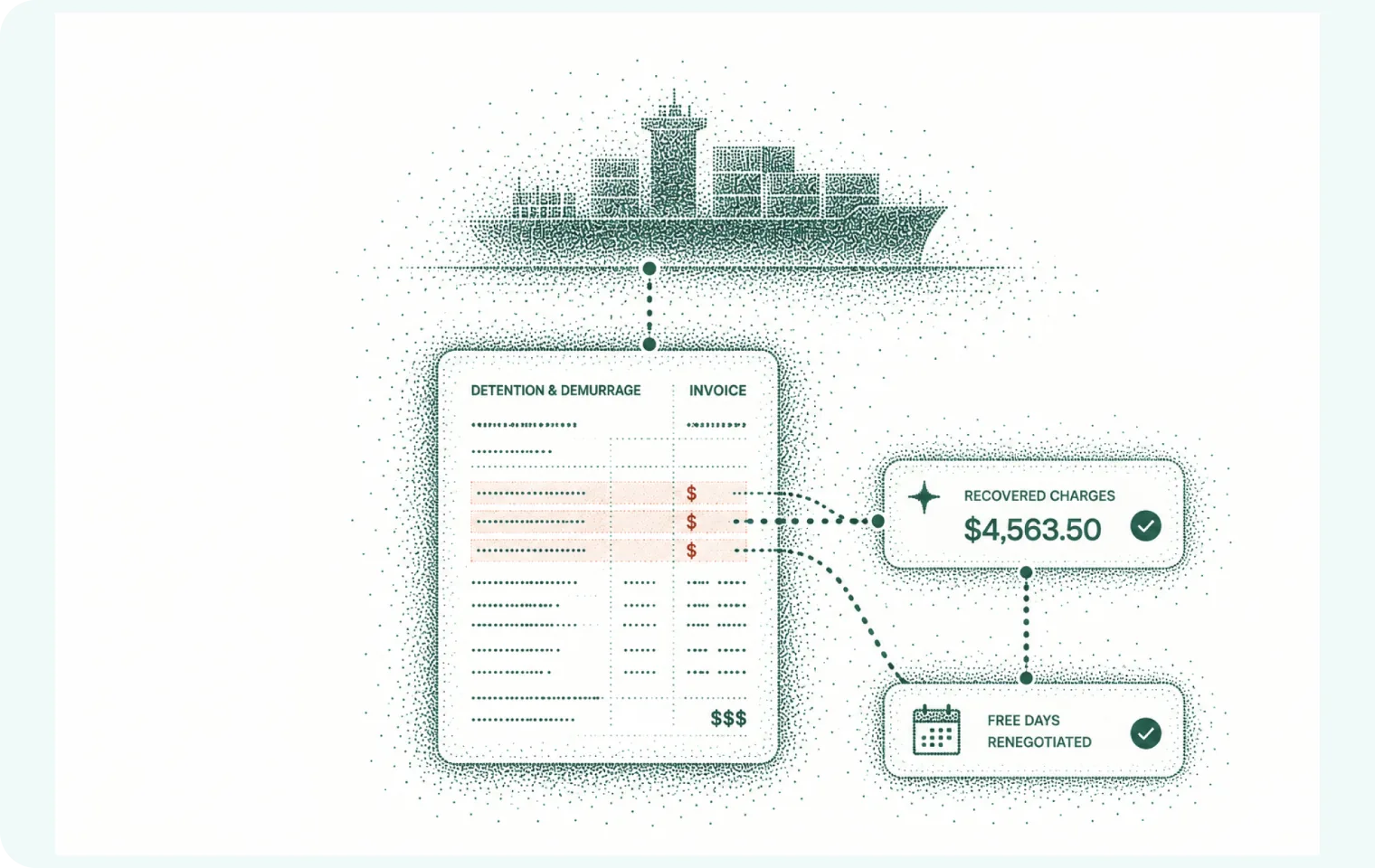
Beacon is built for mid-market ocean importers and can be live in weeks. Its freight invoice audit and verification matches each ocean freight invoice, including demurrage and detention, to the contract and to the shipment, and flags what does not add up. It does not replace an owner for the P&L line. It gives that owner a number they can check.
See freight invoice audit and verification, the method in How to check whether your ocean freight invoices are correct, and Beacon's D&D control.
Related guides: What is demurrage?, What are detention charges and how are they calculated? and How to calculate demurrage charges.
FAQ
What is the difference between demurrage and detention?
Demurrage is charged while the full container remains inside the terminal after free time. Detention is charged after the container has left the terminal and is not returned empty within the allowed free time. They can have separate clocks, or one combined clock, depending on the contract.
Where should demurrage and detention sit in the P&L?
Give them their own general ledger lines, or a sub-analysis you can extract at month end. If they are rolled into freight or absorbed into cost of goods sold, the cost is still in the accounts, but it has no owner. FRS 102 Section 13 and IAS 2 set the test for what may be included in inventory cost. They do not require the charge to be invisible.
Who should own the D&D number?
Finance should own recognition and cut-off. Logistics should own the explanation of the events. Procurement should own the contract record used to check the invoice. One of those three, named, should be accountable for the P&L line.
How are detention charges calculated?
Chargeable days after free time, multiplied by the daily rate that applies to each of those days, including any rate tiers. The clock is set by the contract and by shipment events, not by the invoice date.
How do I accrue for D&D before the invoices arrive?
At period end, list every container with incurred chargeable days and no posted invoice, rebuild the amount from contract free time, rates and events, and post an accrual. True it up when the invoice arrives. FRS 102 paragraph 2.36 requires the accrual basis, except for cash-flow information.
How do I check a D&D invoice against the free time in our contract?
Match the invoice to the container, read the free time and rates from the governing contract, confirm the event dates from the shipment record, rebuild the days and the tiers, and compare. The method is the same three-way match used for other ocean freight invoice lines.
Does a D&D invoice always include the dates I need to check it?
No. Even where a rule requires free-time dates and the dates charged, as 46 CFR 541.6 does on in-scope US trades, the invoice may still omit the gate-out or empty-return dates. You need the shipment record as well.
Can our ERP do this on its own?
An ERP can store the invoice and the payment. It will not, on its own, match that invoice to contract free time and to shipment events. That is what freight invoice audit and verification, or a managed service, is for. Beacon does this for ocean freight, including D&D.
Sources
External facts in this article are taken from the following. Nothing else in the article is presented as a statistic.
- Financial Reporting Council, FRS 102 The Financial Reporting Standard applicable in the UK and Republic of Ireland, Section 2 paragraph 2.36 and Section 13 paragraphs 13.5, 13.6, 13.11 and 13.13. https://www.frc.org.uk/library/standards-codes-policy/accounting-and-reporting/uk-accounting-standards/frs-102/
- IFRS Foundation, IAS 2 Inventories (cost of inventories includes costs of purchase, conversion, and other costs incurred in bringing inventories to their present location and condition). https://www.ifrs.org/issued-standards/list-of-standards/ias-2-inventories/
- Wiss, "Drayage Cost Accounting: Port-to-Warehouse Expense Management", 3 June 2026, on D&D being posted into general freight accounts and on why separate coding changes who can see the cost. https://wiss.com/drayage-cost-accounting-port-to-warehouse-expense-management/
- 46 CFR 541.6 (contents of a demurrage or detention invoice) and 46 CFR 541.5 (consequence of missing required information), for US trades in scope of the Federal Maritime Commission's billing rules only. https://www.ecfr.gov/current/title-46/chapter-IV/subchapter-B/part-541