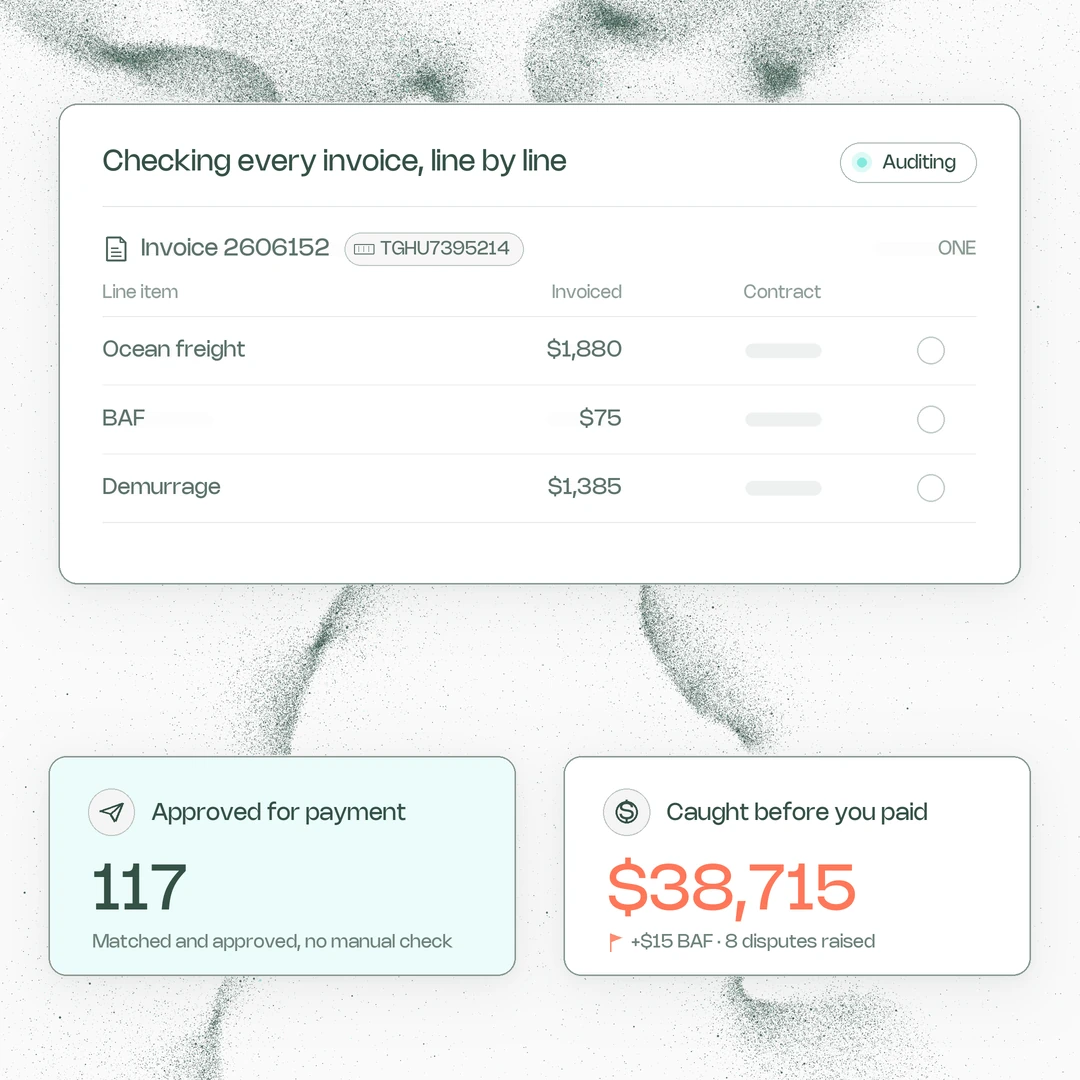
Key takeaways
To check an ocean freight invoice you need three records: the invoice, the governing contract (and amendments), and what actually happened to the shipment.
- A total that matches the contract can still be wrong if lines have been split or merged, or if a surcharge sits inside the base rate.
- Accessorial charges such as demurrage, detention and storage cannot be verified from the invoice alone. You need event dates and the free time in the contract.
- In one UK food importer's invoices (101 invoices): 54.5% had at least one error; 11.7% of invoice value was overbilled; 16.9% was billed wrongly in total; two surcharge lines drove 84% of line-item overbilling.
- Some contracts require invoice queries within seven days, which can be much shorter than the payment terms on the same document. Check the clause first.
- An ERP can store the invoice. It will not, on its own, complete a three-way match against the contract and the shipment. Freight audit software or a managed service can. Beacon checks every ocean freight invoice against your contracts and shipments.

How to check your ocean freight invoices are correct.
To check whether an ocean freight invoice is correct you need a three-way match: the invoice, the contract it was billed under including every amendment, and a record of what actually happened to the shipment. Comparing the invoice to the contract alone will catch a wrong rate. It will not catch a charge for an event that never happened, and those are the charges that are hardest to find and hardest to recover once paid.
This guide is written for the person who approves ocean freight invoices and the finance lead who owns the number. It matters beyond any single overcharge. Unchecked invoices become your freight-spend data. That data becomes your budget baseline, and the baseline is what you take into the next renewal, opposite a carrier whose own numbers are complete.
Most teams only have the invoice in front of them when it is approved. The rest of this guide is the method for checking it properly, by hand or with software, before the dispute window closes.
Why ocean freight invoices are hard to check
An ocean freight invoice is not one price. It is several kinds of charge stacked into one document, and they are not verified in the same way.
The four layers of an ocean freight invoice
That last row is the problem. Accessorials exist only because something happened, or failed to happen, at a specific moment, and an invoice does not describe events.
What the terms on your ocean freight invoice mean
Carriers abbreviate inconsistently. These are the terms that cause the most confusion, and the ones worth knowing before you start.
Freight invoice terms and what to watch for
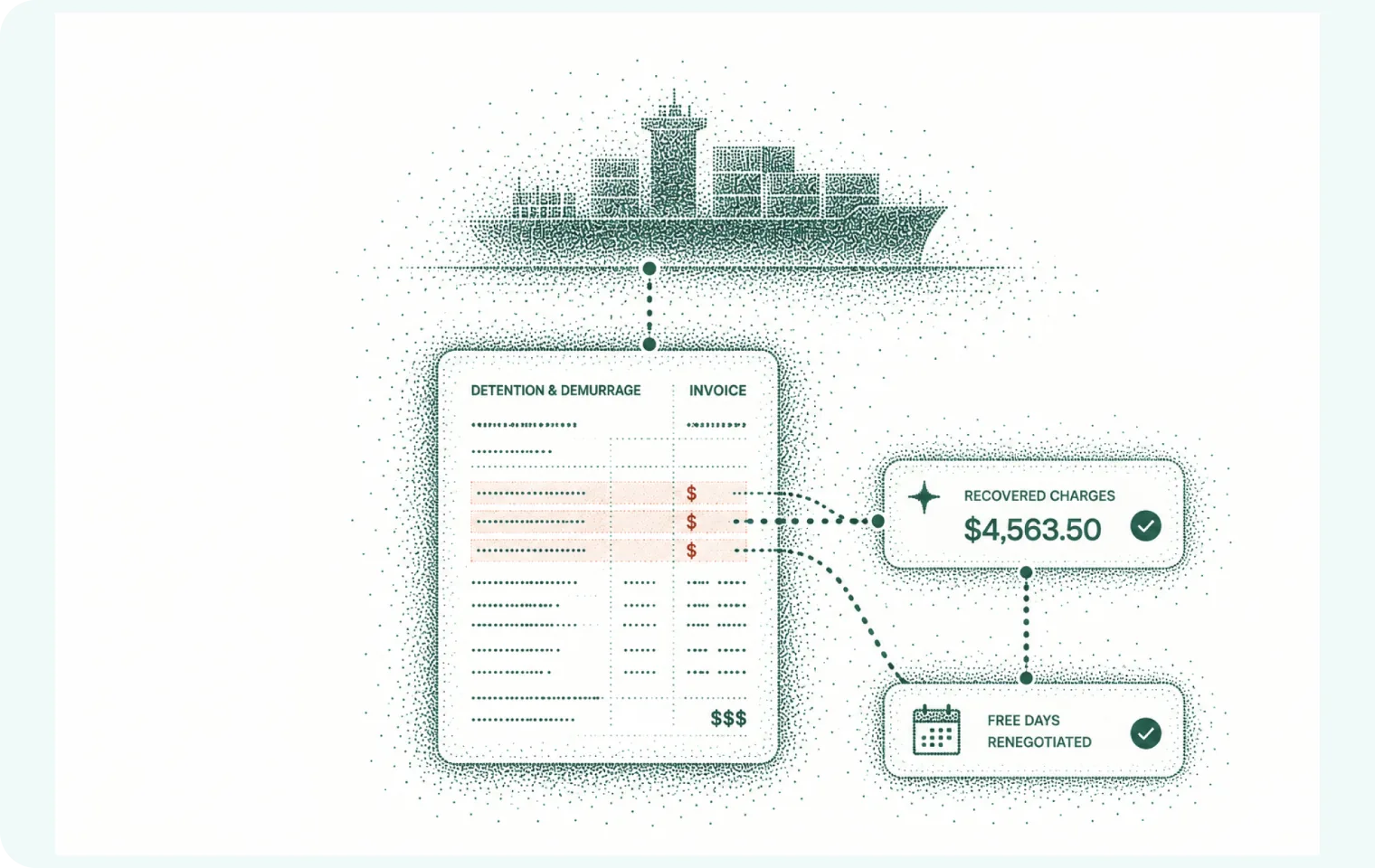
If demurrage and detention are your biggest lines, see Beacon's guide to D&D control.
How do you check an ocean freight invoice against a contract?
This is also the answer to "How do I check my ocean freight invoices are correct?" and "How do I check carrier invoices against our contracted rates?" Work in this order. It finds the most money fastest.
Step 1. Find the contract row that governs the invoice.
Match on origin, destination, carrier, equipment size, equipment type and service level. A port-to-port rate and a port-to-door rate between the same two ports are different rows at different prices.
Then confirm your rate card was valid on the date the invoice used to price the charge. That is usually the price calculation date, not the invoice date, and the two can be weeks apart.
Step 2. Match every line, in both directions.
Take each invoice line and find its counterpart in the contract. Then take each contract line and confirm it appears on the invoice. A missing line is as informative as a wrong one, and it is the check people skip.
This is also how you spot surcharges billed on top of your contract rates: they appear as extra lines, or they disappear into a merged total.
Watch for two patterns that both survive a total-to-total comparison:
- A split charge. Two invoice lines that sum exactly to one contracted charge, where the second is a product you never agreed to.
- A merged charge. A base rate and a variable surcharge arriving as one number, so the total is right but the surcharge can no longer be seen or challenged.
Reconcile line by line, or you will miss both.
Step 3. Test every accessorial against what actually happened.
For each demurrage, detention, storage or accessorial charge you need the vessel arrival, the discharge date, the date the container became available, when free time started and expired, and the daily rate applied.
If you cannot establish those, record the charge as unverified rather than assuming it is correct. A charge for a container that was never actually held will pass every rate check you run, because the rate was right. Only the event data shows whether the charge should have been billed at all.
How much of our ocean freight spend is overbilled, and how would we find out?
There is no industry figure you should treat as your number. The useful question is what you find on your own invoices, using the three-way match above.
When Beacon ran that check across one UK food importer's full set of 101 invoices, 54.5% had at least one error. 11.7% of invoice value was overbilled and 16.9% was billed wrongly in total. Two surcharge lines drove 84% of line-item overbilling. That is one customer's complete invoice run, not a sample, and it sits above the 5% to 7% of invoice value we typically see billed incorrectly across importers.
Two things follow from it, without treating it as a forecast for any other business. First, errors can concentrate in a small number of surcharge lines, so the check is not an argument about every line on every invoice. Second, a sample of invoices, or a check of base rates only, will miss that pattern. To find your own figure you need to check all three records, including accessorials, and log the results by charge code.
Do you need freight audit software, or can an ERP do this?
An ERP can store invoices, and sometimes a contracted rate. That is not the same as checking every line against the contract and the shipment. A managed freight-audit service can do the check for you, usually on a cycle and sometimes on a sample. Software can run the same three-way match on every invoice, as soon as it arrives.
ERP, managed audit service, or freight audit software
Beacon is software for that third job: invoice audit and verification for ocean freight, checked against your own contracts and shipments.
How do you dispute a freight invoice?
Check the dispute clause before anything else, because it sets your timetable. This section is about evidence and process. It is not advice on how to negotiate rates or free time.
Some contracts require queries within seven days of the invoice date, while payment terms on the same document may be 30 or 60 days. The window to challenge can close long before the money leaves, and internal routing can consume most of that week before anyone reads the document.
Raise a holding query in writing inside the window, even if you are not yet certain. A rough query on day five can preserve your position. A complete one after the window may not.
Ask explicitly for the event data: discharge date, availability date, free time expiry, daily rate applied. For a storage or demurrage charge this is the substance of the query, and asking creates a record that the invoice did not contain it.
Log outcomes by charge code, not only by invoice. One corrected invoice is a single case. The same code applied the same way many times is a pattern you can take back to the record.
Prefer to query before payment. Recovery after a charge has been settled is harder, which is one reason the short window exists.
For ocean demurrage and detention, the US Federal Maritime Commission's billing rules set out what a compliant D&D invoice must contain. That is a useful benchmark even outside the US.
Why checking invoices by hand does not scale
Checking four invoices properly takes an afternoon. A business moving 3,000 containers a year will see two or three invoices per container and five or six lines on each, which is somewhere between 30,000 and 50,000 invoice lines once accessorials are counted. Each one needs a contract row, an amendment history and a shipment event to verify.
That is why the honest answer to "what proportion of your ocean freight invoices are checked line by line" is usually "a sample", and often "none".
The consequence is worse than a single overcharge. An overcharge caught inside the dispute window can still be queried. A baseline built on unchecked invoices repeats every year, and it is the number you defend at renewal.
For the wider picture of paper rate versus paid rate, see Are you overpaying for your ocean freight?
Frequently asked questions
How do I check my ocean freight invoices are correct?
Use a three-way match: the invoice, the governing contract including amendments, and a record of what actually happened to the shipment. Match the contract row first, then every line in both directions, then every accessorial against event dates and free time. Beacon runs this check on your own invoices, contracts and shipments.
How do I check carrier invoices against our contracted rates?
Find the contract row that matches origin, destination, carrier, equipment and service, valid on the price calculation date. Then match every invoice line to the contract and every contract line to the invoice, so a missing or added surcharge cannot hide in the total.
How do I spot surcharges billed on top of our contract rates?
Look for extra lines that are not in the contract, and for base rates that have absorbed a variable surcharge so the surcharge can no longer be seen. A total that matches the contract is not enough.
How much of our ocean freight spend is overbilled, and how would we find out?
You find out by running the three-way match on your own invoices and logging the results by charge code. In one UK food importer's full run of 101 invoices, 54.5% had at least one error and 11.7% of invoice value was overbilled. That is a finding from that set of invoices, not a forecast for yours.
Do we need freight audit software, or can our ERP check freight invoices against contracts?
An ERP can store the invoice and sometimes a rate. It will not, on its own, match every line to contract amendments and shipment events. A managed service can do the check on a cycle. Software such as Beacon can run it on every ocean freight invoice once the contracts and shipments are connected.
Can I check a freight invoice without shipment data?
You can check the base rate and most itemised surcharges against your contract. You cannot verify accessorial charges such as demurrage, detention or storage, because those depend on when events occurred and an invoice does not record events.
How long do I have to dispute a freight invoice?
It depends on the contract. Some clauses specify seven days from the invoice date, which can be much shorter than the payment terms. Check the clause rather than assuming you have until the due date.
How do you dispute a freight invoice?
Query in writing inside the contractual window, ask for the event data that the invoice does not contain, and keep a record by charge code.
What is an accessorial charge?
Any charge on an ocean freight invoice that is not base freight. It includes demurrage, detention, storage, quay rent, and handling charges triggered by a specific event. Accessorials are where unverified charges concentrate, and they cannot be checked without shipment data.