
A trade lane (or trade route) refers to a specific pathway along which goods are transported between two or more locations, typically across international borders. Trade lanes are established based on the flow of goods and the economic relationships between countries or regions. They encompass both maritime and air routes and play a crucial role in global supply chains by facilitating the movement of goods and fostering international trade.
Transit time refers to the duration it takes for goods or shipments to travel from their origin to their destination. It is a crucial metric in supply chain and logistics management, as it directly impacts delivery schedules, inventory levels, and customer satisfaction. Transit time encompasses the entire journey of a shipment, including transportation, handling, and processing at various checkpoints along the route.
Transloading refers to the process of transferring goods or cargo from one mode of transportation to another, typically from one type of truck or railcar to another, or from rail to truck and vice versa. This logistical practice is often employed to optimize transportation routes, reduce costs, and improve overall efficiency in supply chain operations.
Transportation lead time refers to the duration it takes for goods to be transported from the point of origin to the final destination. It encompasses the time required for transportation activities, including loading, transit, and unloading, across various modes of transport such as road, rail, air, or sea.
A Transportation Management System (TMS) is a specialized software solution designed to streamline and optimize transportation and logistics operations within supply chains. It provides functionalities to effectively manage and control the movement of goods from origin to destination.
A transshipment is the process of transferring goods from one transportation vehicle or vessel to another during their journey from origin to destination. It typically occurs at intermediary points along the supply chain route, where cargo is transferred between different modes of transportation, carriers or vessels.
Twenty-foot Equivalent Unit (TEU) is a standard unit of measurement used in the shipping industry to quantify the cargo-carrying capacity of container vessels. It represents the volume of a standard twenty-foot-long shipping container.
An Ultra Large Container Vessel (ULCV) is a massive container ship used on major trade routes, capable of carrying over 14,000 TEUs.
Vendor Managed Inventory (VMI) is a supply chain management strategy where the supplier or vendor takes responsibility for managing the inventory levels of their products at the customer's or retailer's location. In this arrangement, the vendor monitors the inventory levels based on agreed-upon criteria such as sales data or inventory levels, and initiates replenishment as needed.
Verified Gross Mass (VGM) is a term used in the shipping industry to refer to the total weight of a packed container, including its contents and packaging materials. It is a crucial requirement mandated by the International Maritime Organization (IMO) under the Safety of Life at Sea (SOLAS) convention to enhance safety in maritime transportation.
A floating structure with its own mode of propulsion designed for the transport of cargo and/or passengers. In the Industry Blueprint 1.0 "Vessel" is used synonymously with "Container vessel", hence a vessel with the primary function of transporting containers.
Vessel bunching refers to the situation where multiple vessels arrive at a port simultaneously or within a short period, leading to congestion and delays. This clustering of vessels can overwhelm port facilities, causing extended wait times for berthing, loading, and unloading operations.
A vessel call sign is a unique identifier assigned to a ship for radio communication purposes. It is used to distinguish the vessel from others in maritime communication systems, including VHF radios and satellite communications.
A vessel omission (sometimes called a port omission) occurs when a scheduled vessel does not call at a planned port during its voyage. This disruption means that the vessel skips the port entirely, which can impact the transportation and delivery schedules of goods.
In cargo shipping, vessel rotation is the planned sequence of port calls that a shipping vessel follows on its route to optimize cargo loading and unloading operations.
The timetable of departure and arrival times for each port call on the rotation of the vessel in question.
A vessel sharing agreement (VSA) is a cooperative arrangement between shipping companies that allows them to share space and resources on vessels for specific routes.
A journey by sea from one port or country to another one or, in case of a round trip, to the same port.
Warehouse utilization is a logistics metric that refers to the effective use of available warehouse space for storing goods and inventory.
Order for specific transportation work carried out by a third party provider on behalf of the issuing party.
Logistics yard management refers to the process of overseeing and controlling the movement of trucks, trailers, containers, and other vehicles within a yard or distribution center. This includes tasks such as scheduling, tracking, and coordinating the arrival, departure, and storage of these vehicles.
.png)
Supply Chain Performance: The Questions Every Leader Should Be Able to Answer
Part one of three. Part two covers risk. Part three covers cost.
What is supply chain performance, and how do you measure it?
Supply chain performance is the degree to which shipments arrive when expected, across all active lanes and carriers. The standard measure is on-time arrival rate: the percentage of shipments that arrive within a defined tolerance of their original estimated time of arrival.
The standard tolerance for ocean freight is plus or minus three days. For air freight, it is plus or minus one day. A shipment arriving within that window is considered on time. Outside it, it is delayed.
Most supply chain leaders believe they have a handle on performance. Most don't. They have visibility into individual shipments. That is not the same thing.
Question 1: What is my network's on-time arrival rate right now?
This is the foundational performance metric. It answers: of all active shipments currently in transit, what percentage are on track to arrive within three days of their original ETA?
A single on-time rate is a starting point. The number that matters more is what it is doing over time. A 74% on-time rate after six months of improvement is a fundamentally different situation to a 74% on-time rate after six months of decline. The trend is the signal. The snapshot is just context.
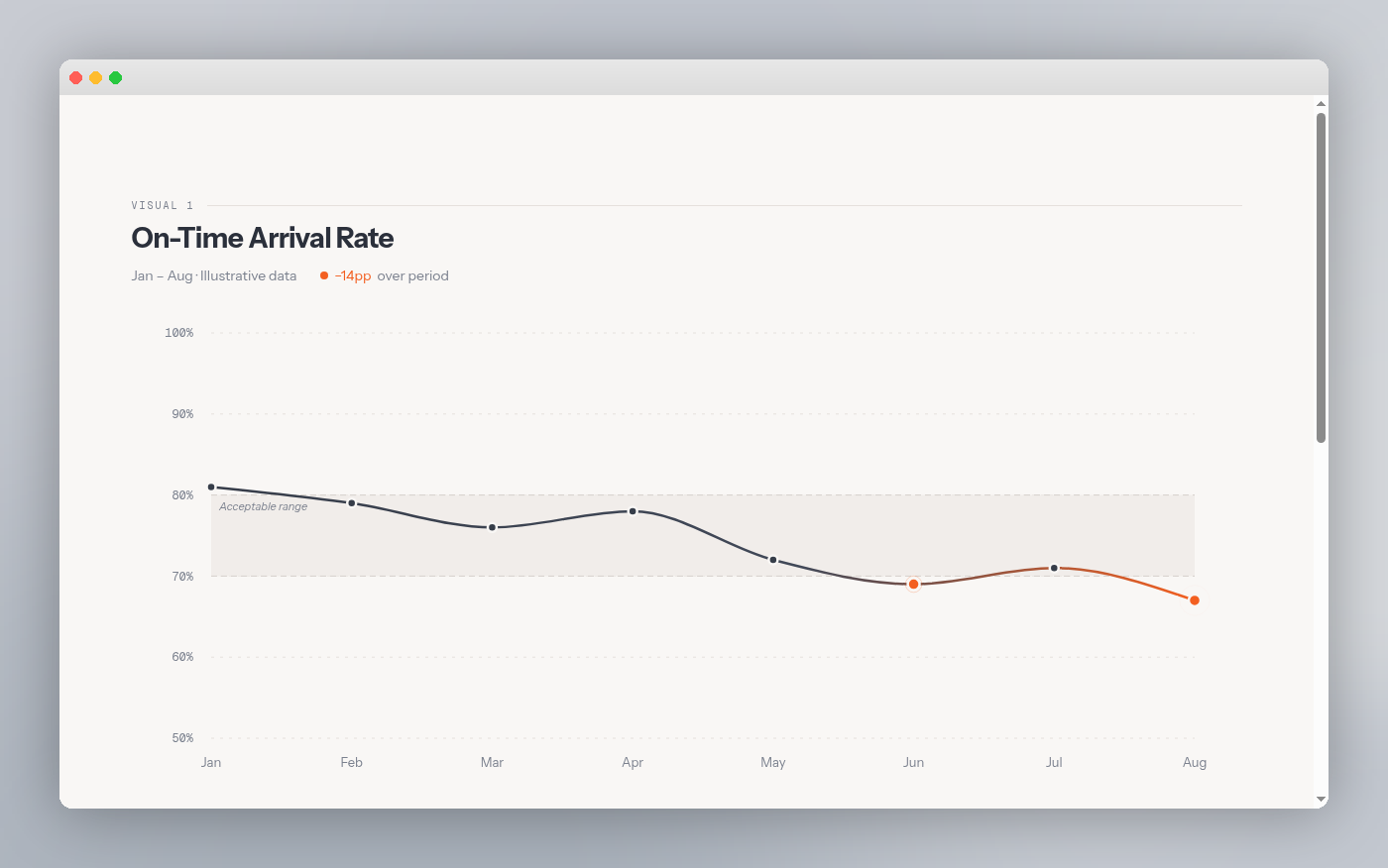
The harder question is: do you actually know your number right now, or would producing it require someone to pull data from a TMS, cross-reference a spreadsheet, and come back to you tomorrow? For most businesses, it is the latter. On-time rate sounds like a simple calculation until you realise it requires your original ETA, your current ETA, and your actual arrival data -- three data points that typically live in three different places, maintained by different teams, updated on different schedules.
Question 2: Which routes and carriers are driving my delays?
Network-level on-time performance tells you how the business is doing. Route and carrier-level performance tells you what to do about it.
The average always hides the outliers, and in supply chain, the outliers are where the operational and commercial attention needs to go. A single underperforming lane can drag a network average down by five or six percentage points. Without route-level data, you cannot see it.
The metric to run: average days late per carrier-route combination, ranked worst to best, across completed shipments in the last 90 days.
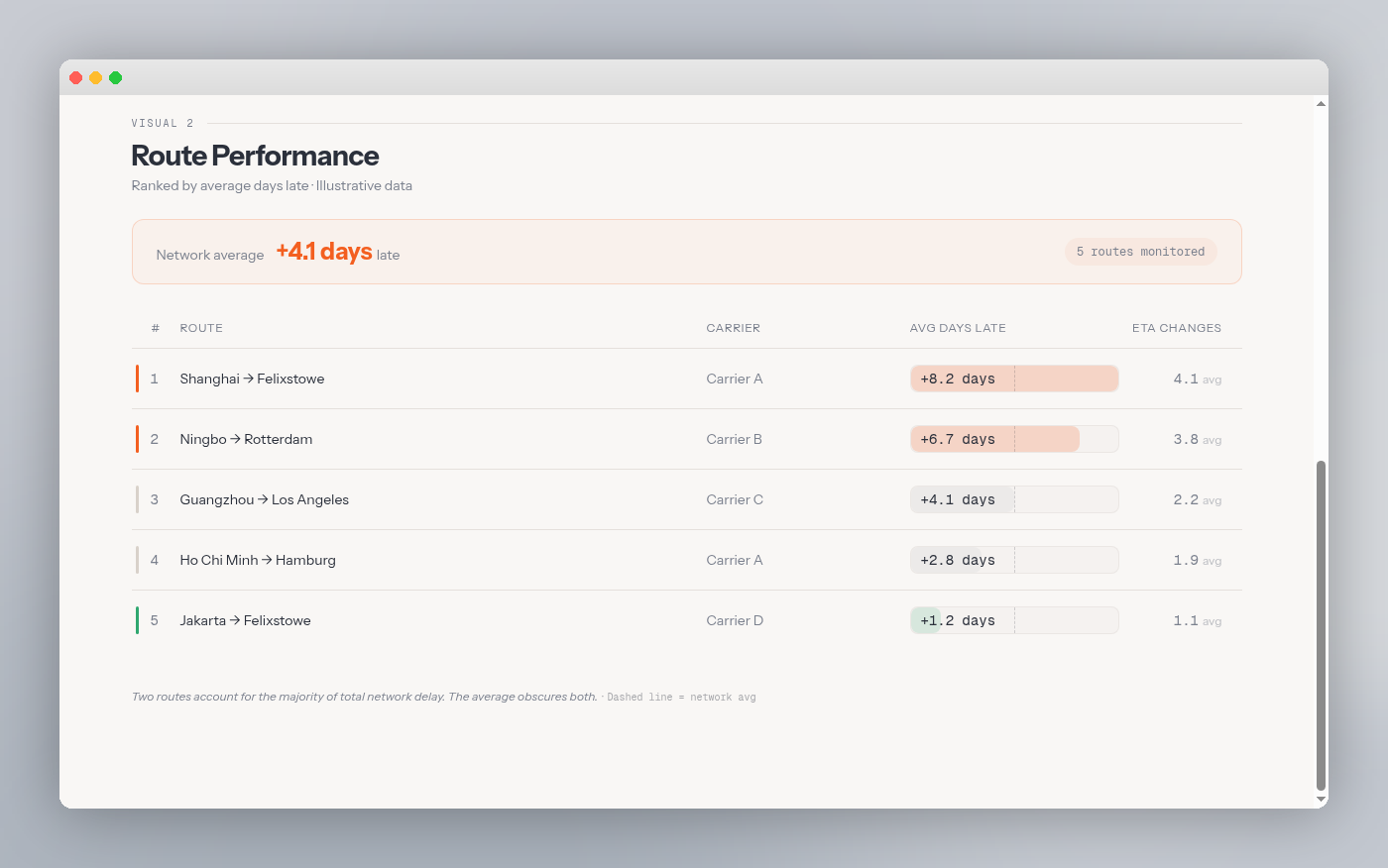
The question worth sitting with: could you produce this breakdown by carrier and route, ranked, without asking your team to build it manually? Route-level performance data requires shipment records, carrier data, and ETA history to be connected in one place. Most businesses have all three data sources. Almost none have them joined.
Question 3: Is my network becoming more or less predictable?
On-time rate measures outcomes. ETA volatility measures instability before the outcome.
ETA volatility is calculated as the average number of ETA changes per shipment combined with the average size of those changes in days. A shipment whose ETA moves five times before arrival is structurally unpredictable, even if it ultimately arrives on time. High ETA volatility on a specific lane often surfaces before delays fully materialise, giving operators a window to act.
The question this raises is whether you would even know if volatility was rising on a specific lane. Spotting it requires tracking ETA changes per shipment over time, not just the most recent ETA. That is a level of historical data capture that most tracking tools do not surface by default. The data exists in carrier systems and port notifications. Whether it is being captured, connected, and monitored is a different question entirely.
Why these questions are harder to answer than they look
None of these three questions are conceptually complex. The challenge is not understanding what on-time rate means or why route performance matters. The challenge is that answering them in real time, continuously, across an entire network, requires data from multiple sources to be connected and current simultaneously.
Original ETAs live in booking systems. Current ETAs come from carrier tracking. Actual arrival times come from port systems or freight forwarders. PO data lives in an ERP. In most businesses, these sources are not connected. Performance management therefore becomes a manual exercise, done periodically, based on whatever data someone was able to assemble. By the time the picture is complete, it is already out of date.
The leaders who manage performance most effectively are not the ones with the best instincts. They are the ones who have stopped relying on instinct because they can see the data directly.


.webp)