Beacon’s supply chain visibility and collaboration platform empowers organizations to achieve more efficient, reliable and sustainable supply chains.
.webp)
Global Port Performance: 2025 in Review
Our analysis of 96 major container ports tracked anchor times across every month of 2025. Anchor time measures how long vessels wait at anchorage before securing a berth, serving as a key indicator of port congestion. All performance rankings are based on 12-month average anchor times, providing a complete view of the year rather than snapshot comparisons.
The global picture
The 12-month average anchor time across all 96 ports was 0.33 days (about 8 hours), with a median of 0.11 days. But these averages hide three distinct realities.
Most ports operated efficiently. 70 of 96 ports (73%) maintained average anchor times under 0.5 days throughout the year. These ports provide reliable service with minimal waiting.
A troublesome middle. 19 ports averaged between 0.5 and 1.5 days of anchor time, enough to disrupt schedules but not severe enough to make headlines.
Seven ports struggled significantly. Chittagong, Mombasa, Manila, Lomé, Port Sudan, Savannah, and Dar es Salaam all averaged over 1.5 days of anchor time across the year.
The year started difficult (January: 0.42 days, February: 0.43 days) and improved through mid-year (June: 0.27 days) before finishing relatively stable (December: 0.32 days).
Most congested ports
Seven ports averaged over 1.5 days of anchor time across 2025. Chittagong led with 1.97 days average, peaking at 4.04 days in April. Mombasa followed at 1.69 days (February peak: 3.62 days), then Manila at 1.58 days (December peak: 2.20 days). Lomé averaged 1.15 days with a dramatic November spike to 3.08 days. Port Sudan (1.14 days), Savannah (1.13 days with a February peak of 3.80 days), and Dar es Salaam (0.96 days) rounded out the list.
Port spotlights
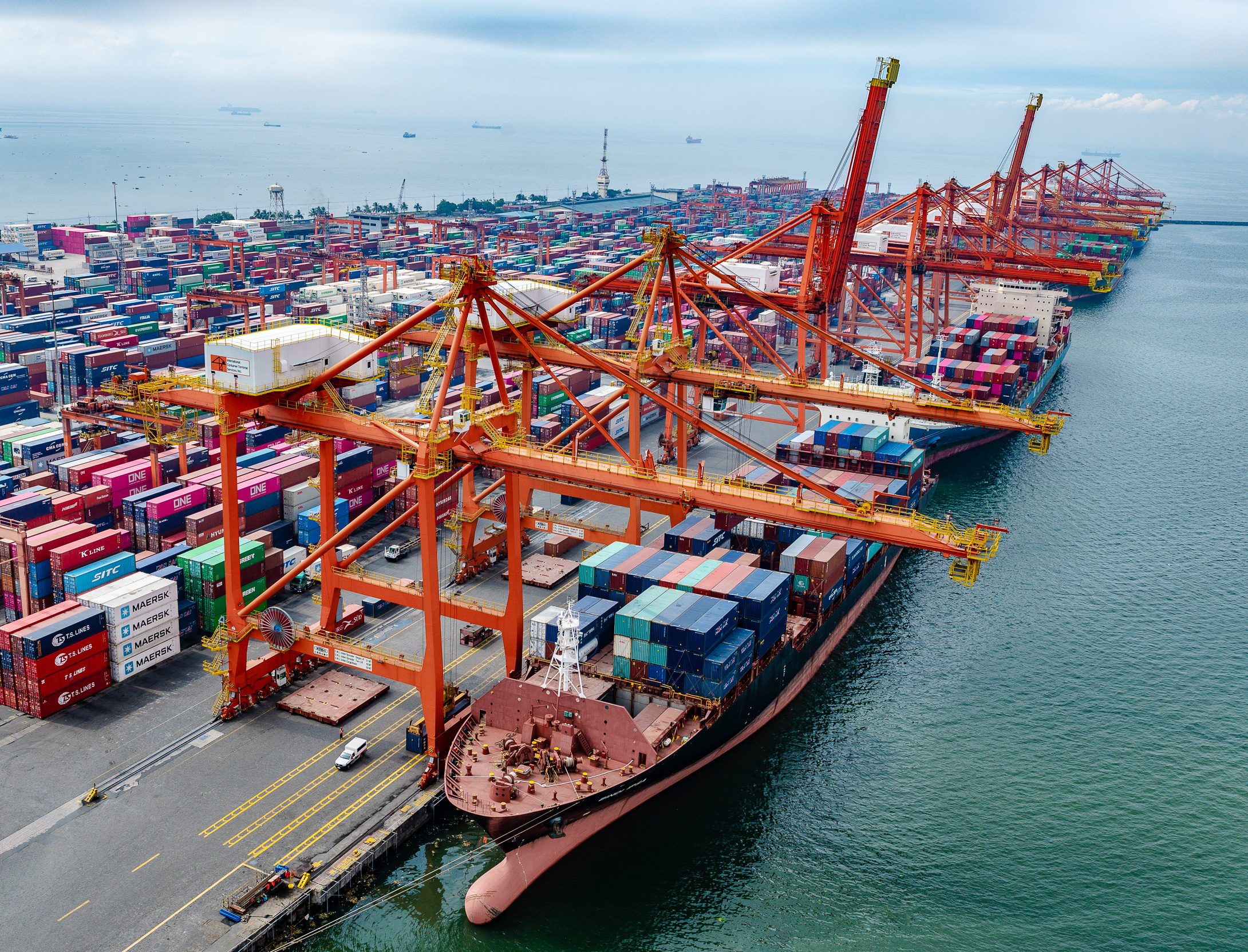
Chittagong: The most congested port in 2025, Chittagong's anchor times peaked dramatically at 4.04 days in April. While conditions improved in the second half of the year (0.35 days in December), the port remained the most volatile globally.
Mombasa: Heavy Q1 congestion (3.62 days in February) improved substantially by mid-year (0.66 days in June), though anchor times crept back up in Q4.
Savannah: The only North American port in the top 10 most congested. Severe February spike (3.80 days) followed by rapid improvement, dropping to 0.45 days by June.
Lomé: Operated relatively well for most of the year before dramatic deterioration in October-November (3.08 days peak).
Most efficient ports
All top 10 efficient ports averaged under 0.04 days (less than 1 hour) of anchor time. Singapore and Qingdao tied for first place at just 0.01 days average, both peaking at only 0.03 days in January. Yokohama matched this performance with a December peak of 0.04 days. Laem Chabang and Busan both averaged 0.02 days, while Hong Kong, Rotterdam, Tokyo, Tianjin Xingang, and Shanghai all maintained averages between 0.03-0.04 days. East Asian ports dominated this list, occupying 8 of the top 10 positions.
Regional patterns
Regional performance varied dramatically across 2025. Sub-Saharan Africa struggled most with a 1.30-day average across 6 ports. Oceania averaged 0.56 days (4 ports), South Asia 0.52 days (5 ports), and North America 0.44 days (15 ports). The Middle East averaged 0.36 days (6 ports), Latin America 0.33 days (10 ports), and Europe 0.32 days (26 ports). Southeast Asia performed well at 0.25 days (12 ports), while East Asia set the global benchmark at just 0.12 days across 12 ports.
Regional insights
Sub-Saharan Africa: The region showed dramatic volatility. Started 2025 with severe congestion (1.77 days in January), improved significantly by mid-year (0.61 days in March), then steadily deteriorated through Q4 (1.78 days in December).
North America: Following severe early-year congestion (0.93 days in February), the region improved dramatically by mid-year (0.26 days in June) and maintained stable performance through year-end.
Europe: Demonstrated consistent efficiency throughout 2025, with minimal variation (standard deviation of just 0.03 days). Every month stayed between 0.27 and 0.37 days.
East Asia: Maintained exceptional performance all year, never exceeding 0.15 days in any month. This region sets the global benchmark for port efficiency.
Volatility: Performance predictability matters
Average anchor time tells only part of the story. Month-to-month volatility, measured as standard deviation across 12 months, reveals which ports provide predictable service versus those where conditions swing wildly.
Chittagong was the most volatile port in 2025 with a standard deviation of ±1.22 days around its 1.97-day average. Mombasa and Savannah both showed ±0.95 days volatility, while Lomé registered ±0.80 days. Manila rounded out the top five at ±0.39 days. High volatility creates planning challenges even when average performance seems acceptable. Savannah, for instance, swung from 3.80 days (February) to 0.45 days (June) an 8x difference that makes reliable routing nearly impossible.
The most stable ports demonstrated that excellence isn't just about low average anchor times, t's about delivering that performance consistently month after month. Singapore, Qingdao, Hong Kong, Yokohama, and Rotterdam all maintained volatility of just ±0.01 days while already operating at world-class efficiency levels.
Key takeaways for supply chain professional
East Asian efficiency remains unmatched. Ports like Singapore, Qingdao, and Yokohama provide sub-0.05-day anchor times year-round with minimal volatility.
Sub-Saharan African ports require careful monitoring. The region showed concerning deterioration in Q4 2025. If routing through this region, build substantial buffer time into planning.
Volatility matters as much as average performance. Ports like Chittagong and Savannah can swing from severe congestion to efficiency within months, making them unreliable for planning despite improved recent performance.
North American improvements were real and sustained. After difficult early 2025, most US ports stabilized by mid-year and maintained improved performance through December.
Sustained trends matter more than single-month snapshots. Ports that showed Q1-to-Q4 improvement or deterioration patterns provide more useful routing intelligence than those with random month-to-month swings.

Beacon Insider: March

.png)